Tuesday, August 17, 2010

Darvaza Gas Crater (June 29-30)

On June 29th, after sleeping in a bit, washing cloths and visiting Yimpash shopping mall again to pick up groceries, having lunch and using the internet (although many things including our blog are blocked), we meet our guide Maksat at our hotel. Maksat is a nice guy, 27 years old, speaks good English and has been working as a guide for a few years since completing his military service. It’s great that he doesn’t have too much stuff, but he does have these huge BBQ skewers and talks about buying a bunch of meat to grill in the desert. This worries us a bit for our nice clean car and we are a little suspect about what kind of meat he plans for all of us to eat. So we tell him we really don’t eat much meat and don’t have anywhere to put it in the car.

We buy gas for our car, which only costs $0.22/liter (but foreigners need to pay a $0.06/ km road tax when entering the country so the total cost comes to something like $2.50/gallon), then head north into the Karakum desert towards the Darvaza gas crater. The crater is 260 km north of Ashgabat on a reasonably good road, then 7 km on a compacted sand road over some dunes. The temperature reaches 108F in mid-afternoon and then gradually cools. About half way there we stop at a small village called Jerbent for tea (photo below) and a smoke for Maksat. Here Maksat also buys some mutton for himself and picks up a greasy pan and an old water kettle that he likes to boil water in over a fire for a better tea taste. We carefully double wrap his meat, pan and kettle in plastic bags and get back on the road.


We see our first camels along the way (photo below) and are fascinated by them. They are really interesting creatures, and it is really cool to see them walk. Later on our trip we will see many more in Turkmenistan, Kazakhstan, and Mongolia, some with one hump, some with two. When we reach the sand road I drop the tire pressure from 35 psi to 20 in the front tires and 15 in the rear tires for better float over the sand.


We are amazed by the Darvaza gas crater. It’s a huge crater with flames coming out of all the crack and crevices. You can smell the gas, you can feel the radiation, and you can see the plumes of hot gas convect out of it (photo below).


So what is this crater in the middle of the desert and why is it on fire? The gas crater is the result of Soviet natural gas exploration in the 1950’s (some sources say the 1970’s). A natural gas rig was installed here but after drilling commenced the earth gave way, causing the rig to fall into the crater that was formed. Natural gas was rushing out of the crater and couldn’t be easily stopped so the workers set the escaping gases ablaze to burn up most of the gas, thinking the well would burn itself out in a few days. Well, it is still burning.

We walk around the crater, taking a bunch of pictures, then move the car to our camping spot about 100m from the crater. We set up camp and have dinner. The temperature is pleasant now with a light breeze. Maksat asks us for a table, a spoon to mix his mutton, a knife to cut an onion and tomato with, and a cup for his vodka. We don’t have a table but give him a piece of cardboard to sit on, Kirstin gives him her spoon for him to mix his mutton, and I offer him my plastic Marlboro cup but he wants something smaller so he uses Kirstin’s cup. I don’t want to give him my knife (maybe I’m a bit strange but I like to keep my pocket knife clean and sharp) but I cut his onion and tomato for him. He is nice enough about it all, we just thought that as our guide he would have brought his own equipment. Kirstin and I enjoy our bread, cheese, apples, Iranian fruit roll-up and soda, while Maksat enjoys his mutton parts, vodka, and a few cigarettes. Different strokes for different folks. I try some of Maksat’s Turkmen vodka, which tastes really good – it isn’t overly strong and tastes a bit like a martini with a hint of olive taste.

After dinner it is dark and I go back to the crater for more amazement and pictures. Soon Kirstin and Maksat join me and we all admire the crater together. The moon rises and the scenery is truly spectacular. Kirstin comments that this would be the ultimate fire temple for Zoroastrians.


The night is chilly but as soon as the sun rises the temperature rises rapidly in the desert and by 7:15 the sun drives me out of our tent. The photo below shows our camp from the hill next to us. We walk to the crater again and inspect it in full sunlight, taking a few more pictures. Now it’s time to pack up camp and head back to Ashgabat, restock and head west to the mountain village of Nokhur. The Darvaza Gas Crater was a pretty cool sight!


Turkmenistan Border and Ashgabat (June 27-30)

We made it through Iran! It was a great adventure and now for the next adventure: Turkmenistan! While everyone has heard of Iran and has their preconceptions, opinions and offered their advice to us, few people I know have even heard of Turkmenistan.

The contrast between Iran and Turkmenistan couldn’t be stronger. It is as sharp as the difference between how much news coverage these two countries receive. I’ve found that most borders are pretty soft, where although there is a well defined border, the cultures of the two countries blend gradually across the border. But this is a “hard” border.

Stepping from Iran into Ashgabat, the capital of Turkmenistan, is a shock. Iranian cities are filled with people, packed with tiny shops, have traffic jams and crazy driving, religion plays a huge role in people’s lives, cities grow organically and there doesn’t seem to be a much central planning. Ashgabat feels empty, is centrally planned and very controlled with countless police and road-side check-points, has gleaming white marble buildings with huge spaces between them, has wide straight freshly paved boulevards with almost nobody driving on them (and when they do they stay in their lanes!), and women wear long, beautiful, colorful dresses and don’t cover their hair. Sadly, much of Ashgabat is built for show, to impress. Kind of like Las Vegas done in white marble. Iran impresses with 3000 years of history and the mish-mash of what this has left; Ashgabat is a capital that is being built from the ground up.

Turkmenistan is a nation of mountains and desert, lies on the east side of the Caspian Sea, has a history of nomadic and semi-nomadic tribes, was part of the Soviet Union until it dissolved in 1991 when Turkmenistan became an independent country. People are predominantly Sunni Muslim, but religion plays a much, much smaller role in most peoples’ lives than it does in Iran.

It takes us two and a half hours to cross the Turkmen side of the border. Not because there are many people, but because of the tangle of red tape and no concept of efficiency. Eventually, after a great amount of waiting, confusion, yelling by one of the officials (louder doesn’t help me understand!), more confusion, more waiting, help from Angela (from our inviting organization), more confusion, waiting and running back and forth, we get our visas, entry travel passes (from Angela) car liability insurance, car entry permit and car obligation, each with its proper stamps. The main delay is that we want to drive to Ashgabat and Darvaza, then turn around and backtrack to Ashgabat before driving to Turkmenbashi and north to Kazakhstan. Our car entry permit, which must list the places we will visit, only has one line and it and does not allow for a change in direction. So in the end we get an car entry permit only to go to Ashgabat and will have to file an car entry permit amendment in Ashgabat (where the form has tons of lines for visiting multiple places).

From the border it is a short drive to Ashgabat, Turkmenistan’s capital. We check into Hotel Aziya, which is a nice place with a huge foyer and large, well equipped rooms. Strangely there are only 20 rooms in this huge building. We organize our things, eat in the Chinese restaurant downstairs in the hotel and I catch up on my journal.

The next day, on June 28th our Turkmenistan adventure begins. In the morning a driver from our inviting organization takes us into town and helps us fill out a car entry permit amendment so that we can see Darvaza, change direction and exit into Kazakhstan. Back at the hotel we give him our entry travel passes and passports and he takes them away for the proper stamps. Antonina from Stantours (our tourist agency – they were great) gives us a lift to Independence Park. Then we spend the rest of the day exploring the city. We are free to see Ashgabat on our own but need to travel with a guide after today when we leave the capital.

In the park we see the Turkmen Independence Monument surrounded by some very impressive Turkmen statues. The photo below shows some of these facing the National Museum.

 
There is a triple wedding celebration and photo session taking place as we walk past the museum.
 

From the monument we walk along at least a kilometer of fountains (see photo below). Ashgabat is in the Karakum desert and water for the fountains, irrigation, etc., must be brought in from the Aral Sea, which has shrunk dramatically and is causing massive environmental damage. The temperature is well over 100F and the sun is blazing so we stop and drink a liter and a half of lemon drink at a shopping mall with a huge water cascade on the outside. On our way back to the hotel, along Turkmenbashi street there is a row of huge marble buildings (almost skyscrapers) that appear to be totally empty. We later learn that each building is full of apartments for one government agency. But the apartments are expensive so few employees choose to live there. Since the apartments are only for employees of that agency the building are mostly empty.


After rehydrating at the hotel we drive to Yimpash shopping plaza (photo below). Turkmenistan is full of surprises and this is one of them. This place is awesome! The first floor is groceries, the second floor is clothes, and the third floor is restaurants, internet computers, bowling, pool, ping-pong, an arcade and a kid’s gym. We buy a ton to drink, lots of food, and a memory stick. This place is as probably the best grocery story we’ve seen on our trip and the first really good store since Germany! We feel like we’ve arrived in an oasis! We drive back to the hotel and drink, drink, drink, then rest a little and have a grocery food dinner in our room.


After dinner we drive downtown to see the main sights of Ashgabat. On the way there I realize that I don’t have my international driver’s license, Turkmenistan insurance, car entry permit, entry travel pass and obligation. I consider going back to the hotel but we are already downtown so we just park and sightsee first (more on this later).

We see the Arch of Neutrality topped with a 12 meter polished-gold statue of President Niyazov, the first president of independent Turkmenistan, which revolves so the former president always faces the sun. Photo of the Arch and Niyazov is shown below.


Next to the arch is a touching earthquake memorial to the victims of the 1948 earthquake (9 on the Richter scale) that killed over 110,000 residents of Ashgabat (2/3 of the population) and a total of 160,000 people in the province of Ashgabat. There is a nice memorial flame and plaque, but above these stands a huge statue of a bull head-butting the earth with destruction and bodies on its top half (photo below). On the top of world sits a Turkman woman (Niyazov’s mother who died in the earthquake) holding up a golden child (Niyazov) to the sky, facing the Arch of Neutrality. Humility was not one of Niyazov’s characteristics. Next to the memorial is a Soviet WWII Memorial and further down the pedestrian park is Ashgabat State University.


It is getting dark and there are police everywhere (that we hear like to check one’s papers and look for any reason to issue a fine) so I suggest we take a taxi to the hotel to pick up our documents before driving our car. After the taxi driver unsuccessfully tries to swindle us into paying double the rate, we are back at our car.

We get into our car and start to head for the hotel but notice that the police on every corner have closed all the roads in our direction. I’ve never seen so many traffic police! At one point I turn left on a street with no one-way signs and no police but 20 m later a police signals me to pull over. I give the young policeman my driver’s license, international driver’s license and my passport. He speaks no English or Russian (I think) because he can’t read my license or Russian page on my international driver’s license. He signals he must write me a citation for going the wrong way on the street I pulled onto and calls someone on his radio, presumably to translate my information. He is very nice and offers us water. 20 minutes go by and nobody shows up to help him. He gets more and more antsy and we ask him if we can go to our hotel. I give him the name of our hotel and repeatedly ask how we can get to Turkmenbashi Street. We are obviously just trying to get home. After another 5 minutes he thankfully lets us go. Phew! I very carefully continue to drive and thankfully find a bigger street with traffic that I can follow past several dozen police check points. After going in the opposite direction of our hotel for a while I can finally turn south and we make it home to our hotel. The next day Maksat (our guide) tells us that maybe the president (Mr. Berdymukhamedov) may have been passing through and this is why all the streets were closed. Happy to be in our hotel we have dinner, watch some Russian MTV videos and go to sleep.

The next day we meet Maksat (our guide) and head north for the Darvaza gas crater but I’m going to jump ahead to June 30th when we return from Darvaza and spend a few hours in Ashgabat again. We buy lunch and groceries at the really cool Russian market, then see the Turkmenbashi Ruhy Mosque on our way out of town (photo below). The mosque has 4 huge minarets, a 61m dome, gleams with white marble and has room for 10,000 worshipers but oddly there is no parking for visitors so Maksat directs us to park our car right on the highway in front of the mosque. We are not allowed to park in the 400 car parking garage but are allowed to park on the highway – different logic than what I’m used to. We admire the mosque but are stunned (especially after spending 2 weeks in Iran and seeing how much religion is a part of peoples’ lives) that there are absolutely no worshipers or visitors in or around the mosque. The only people there are some soldiers guarding the mosque, a man that lets us in and three women vacuuming the carpets. It’s sad that this place was apparently built just for show and that people don’t come here. Next to the mosque is President Niyazov’s mausoleum but other than some soldiers guarding it nobody is here either. We walk back to our car and continue our drive out of the city.


Thursday, August 12, 2010

Final Days in Iran (June 23-27)

Shiraz and Persepolis mark the southernmost point of our trip at 29 degrees north of the equator (Dunnet Head Scotland was our northernmost point at 58 degrees north). Now it’s time to start heading north again towards Turkmenistan. So on June 23rd we drive northeast towards Yazd and see a couple of nice things along the way. One of them is a beautiful cypress tree that is 4000-5000 years old. The tree is gorgeous, symmetric and surprisingly green and full of fruit.


In Yazd we check into Fahadan Great Hotel and it really is a great hotel. It is the grandest hotel of our trip so far (this and Hotel Venus in Pamukkale, Turkey are probably the nicest). Like our hotel in Shiraz, Hotel Fahadan is built in the model of a traditional Iranian home with a courtyard in the middle. This time, however, our room and bathroom are grand in the style of a real luxury hotel. The courtyard is beautiful and our room is filled with artifacts and artwork. The natural gas powered air conditioning also works great.

We are exhausted after a long day but Darius orders us drinks, which he calls the hotel’s welcome drinks. The hotel brings us drinks and an American flag in a little flag holder. Here we are in Iran, sitting on a beautiful Persian carpet in our hotel’s courtyard, sipping delicious ice cold extract drinks with an American flag in front of us. It is such a kind and welcoming gesture, but a bit much for me so I ask if the hotel also has an Iranian flag. They do so now I’m happy to sit in the courtyard with Kirstin and Darius with our two flags. I think this is the first time I’ve seen these two flags displayed next to each other. Wouldn’t it be nice if governments could act more like this?


The next day (June 24th) starts with more hospitality. After a nice breakfast we walk outside to our car and all three of us gasp and are bewildered when it appears our car isn’t there. Has it been stolen? After a few seconds we realize the hotel staff have wrapped our car with a cloth car cover! All the other cars don’t have covers on them but we are the honored guests and once again get super special treatment. Here’s Kirstin in front of our wrapped-up car.


Yazd is a city that has a large minority of Zoroastrians. After unwrapping our car we drive to the Zoroastrian Towers of Silence (Dakhmeh-ye Zartoshtiyun). Darius tells us about Zoroastrians: It is the first monotheistic religion and Zoroastrians believe in one main god with about 10 helper gods and they see life as a struggle between good and evil. They believe earth, air, water and fire are four sacred elements that must be revered and always kept clean. Darius says that because of this their society was probably the cleanest there was. Zoroastrians believe that dead bodies contaminate the earth so they used to lay them on stones inside of these towers and the vultures would pick the bones clean. Today Zoroastrians are buried in concrete coffins so their bodies do not contaminate the earth. We hike up the towers and enjoy great views of the Zoroastrian funeral homes next to the towers, the modern Zoroastrian cemetery, and the city of Yazd. After coming down from the towers we visit several of the funeral homes and the modern cemetery. Darius tells us that Zoroastrians are buried facing up, looking to heaven. Muslims are buried on their side with their eyes facing Mecca. The photo below is taken from inside one of the funeral homes looking up at one of the towers.


We eat lunch in a traditional restaurant in an old bathhouse and then visit a Zoroastrian temple and a traditional wind catcher (a device that funnels cool wind into a home to act as a natural and quite effective air conditioner). We decide to go back to the hotel a bit earlier today to catch up on e-mail, laundry, grocery shopping, write a birthday card and rest a bit. Reluctantly, Darius agrees. I’m sure he would have shown us 10 more things. When we buy some fresh and delicious bread in a tiny bakery around the corner from our hotel the bakers refuses to take any money, even after I offer money three times to one baker and then three times to another (more hospitality). So I bring the bakers some Starburst candy that we still have from home, and they accept this.

After a nice dinner in our room I wash our car with a guy from the hotel with the chamois cloth that the Bradburys gave me in England. This thing is great! Then I join Darius in the hotel courtyard, where he is smoking a lemon water pipe. Darius gives us 3 CD’s that he had copied from the cool café in Hotel Julfa in Esfahan, 2 CD’s from Hotel Fahadan in Yazd, a handkerchief from Hotel Fahadan and a few postcard pictures of the hotel. He and the hotel are so nice. We go to bed at 10:00, which is the earliest we have in a while, but it’s good because tomorrow we need to drive 920 km through the desert from Yazd to Mashad, which I estimate will take us 15 hours.

On June 25th we cover the most distance in a day during our time in Iran – 570 miles or 920 km. Darius isn’t feeling well (he thinks he ate something bad) but feels better as the day goes on. The road goes through a huge desert and the temperature reaches 105F. I drive for 11 hours, then Kirstin takes over for 2 ½ and then I finish the drive into Mashad. We get to our hotel just before 8:00 while it is still light out and traffic isn’t so bad. This is our last city in Iran. I’m really happy that we have made it through the traffic of all of the cities we visited without any accidents. I think we are going to make it! Not that I thought we wouldn’t but after what you see on the news and what so many people were telling us, it is a relief. We have dinner and go to sleep.

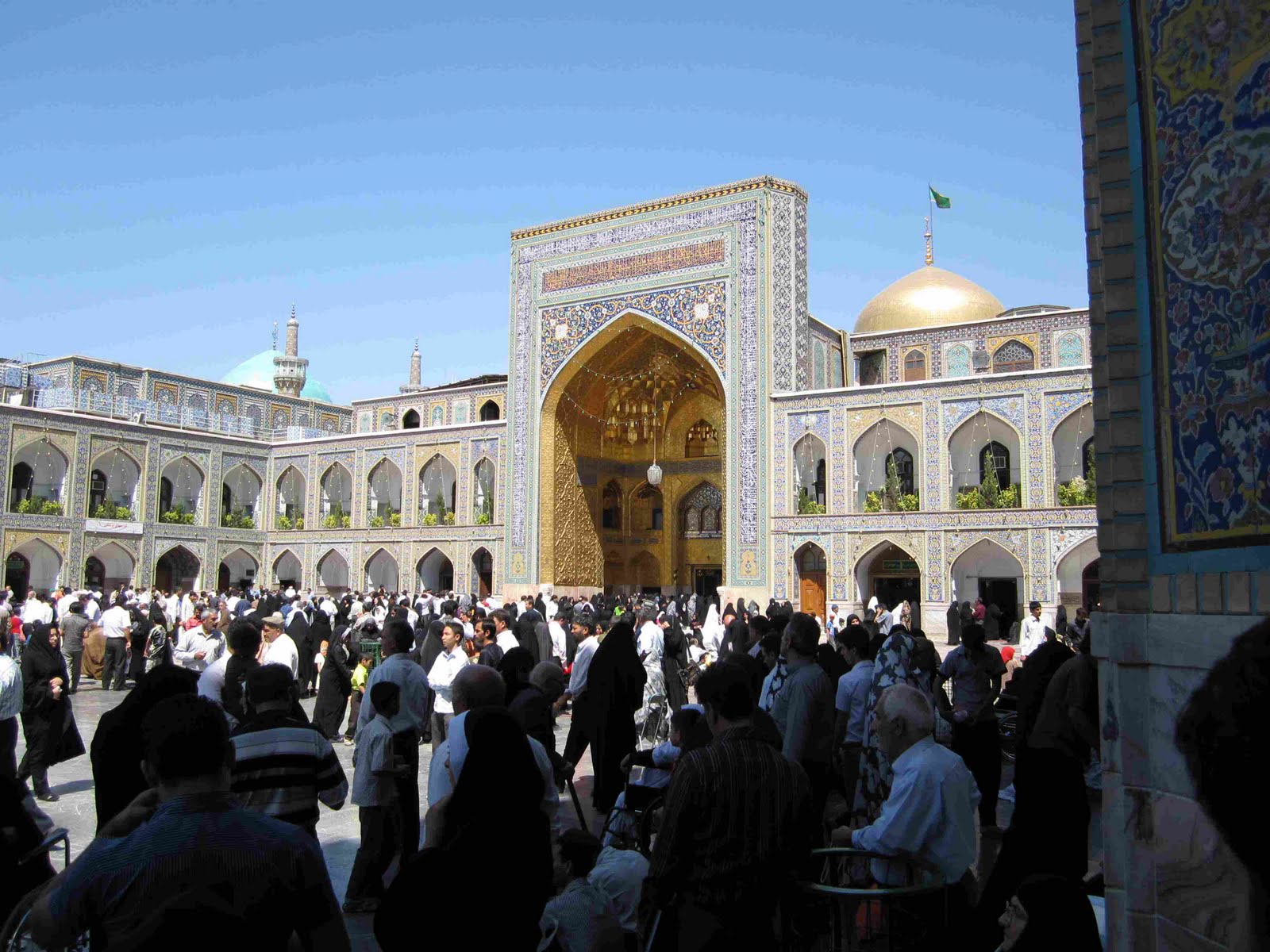
On the morning of June 26th we visit the Shrine of Imam Reza in Mashad, which is the most important Shiite Shrine in Iran. Imam Reza was one of the 11 Imams of Shiite Islam and is entombed here. The Shrine is one of the marvels of the Islamic World and Lonely Plant writes that this complex will most likely be seen as the defining architectural achievement of the Islamic Revolution.

Sunnis and Shiites disagree on who the successor of Mohammed is. Shiite Muslims believe there have been 11 Imams (leaders or saints) since Mohammed. The 12th one is the final one. He disappeared into a cave under a Mosque in Samara in 874 AD and will one day return with Jesus at his side at the end of the world.

As we approach the shrine it becomes clear what a big deal this place is. People from all walks of life are coming to the shrine to pray. Below is a photo of a clergy man just outside the gates of the shrine.


The shrine of Imam Reza is a huge complex, basically a small city that is filled with incredibly detailed artwork and architecture and is packed with pilgrims. Non-Muslims are not allowed in the tomb area but are allowed to visit the rest of the complex, provided they dress and act properly. For Kirstin this means putting on a chador, which can be checked out just outside the shrine. She doesn’t like the way it makes her feel, and I agree that unlike a headscarf and manateau, a chador is really very different from what women wear outside of Iran.

There is no way to capture the look or atmosphere of the shrine but the photo below is one part of one of many, many squares surrounded by architecture covered in millions or I think billions of small tiles.


After visiting the shrine we take a long walk to a “stone park” where we sit by some water, then climb the rock hill with beautiful views of Mashad and a lovely breeze at the top (photo below).


Then we take a long taxi ride to a pizza restaurant and back to our hotel. Kirstin and I go to an internet café while Darius buys his train ticket to get back home to Tehran after we will leave him at the border tomorrow.

The next day (June 27) we begin our drive to the border really early because Darius’ train from Mashad to Tehran leaves at 1:00 and he’ll need to take a taxi to the train station in Mashad to catch it. The drive out of Mashad goes smoothly and the road to the border is in excellent shape and we make great time. Below is a photo of the scenery on the drive.


As we approach the border I notice that the border in my GPS is a bit off. The map says we are in Turkmenistan but we have not reached the Iranian border point yet so we are certainly still in Iran. So don’t trust your GPS maps if you are near a sensitive border!

We arrive at the border just before they open at 8:00 a.m. Darius helps us with the border formalities on the Iranian side and then gives me the t-shirt that he bought in Esfahan (it has a Zoroastrian symbol on it and says “Persian”) and says since he has been wearing it during the trip it should remind us of him. I promise to send him one of my shirts when I get home. Kirstin and I give him a Michigan baseball cap and thank him for being such a wonderful guide. It is sad to see Darius go. We have had a wonderful time in Iran and a big part of that was Darius. So thank you Darius!

With Darius gone the gate is opened and we drive through but the Iranian soldier at the border gate tells us to go back. It turns out we didn’t get an exit stamp. The old man that opened the gate gets chewed out for letting us through. After a little waiting we get our stamp. Phew! At 9:30 we cross the border and enter Turkmenistan.

Iran has been a highlight of our big trip and an incredible experience. We will never forget our time here! We experienced fear in coming here, noticed censorship of the New York Times, Skype, Facebook and our blog while in Iran, and were told a million times that our lights are on; but we were rewarded with amazing Persian history, Islamic architecture, and a hospitality like nowhere else. The Iranians we met were able to separate political differences from person-to-person kindness better than any other people I’ve ever met. Most Iranians are deeply religious and we admired many of the things that Islam teaches. We survived the crazy traffic in the cities and Kirstin looked great in her headscarf and manateau. We had a wonderful time and a terrific guide, and we learned some things about Persian identity and ultimately about ourselves.

Wednesday, August 11, 2010

Shiraz and Persepolis (June 21-23)

Persepolis is an archeological ruin of an ancient city just outside of Shiraz in the southwest of Iran and is the last of three things that I was really looking forward to seeing in Iran.

Since we left Esfahan rather late in the day on June 21st our 500 km drive to Shiraz brings us into the city just as it is getting dark and rush hour is at its worst. Our hotel is also on the opposite side of the city from where we arrive so I have to deal with another crazy evening in traffic. Finally we find our hotel, Niayesh Boutique Hotel, a traditional Iranian home converted into a hotel. The home/hotel is a series of rooms centered about a beautiful courtyard (see photo below). Our room has tons of character, the hotel management is super nice, and they even show me a good place to park our car and then drive us back to the hotel in a motorcycle-powered, 3-wheeled vehicle that is half Indian rickshaw, half Pope-mobile. We enjoy a nice dinner in the courtyard.


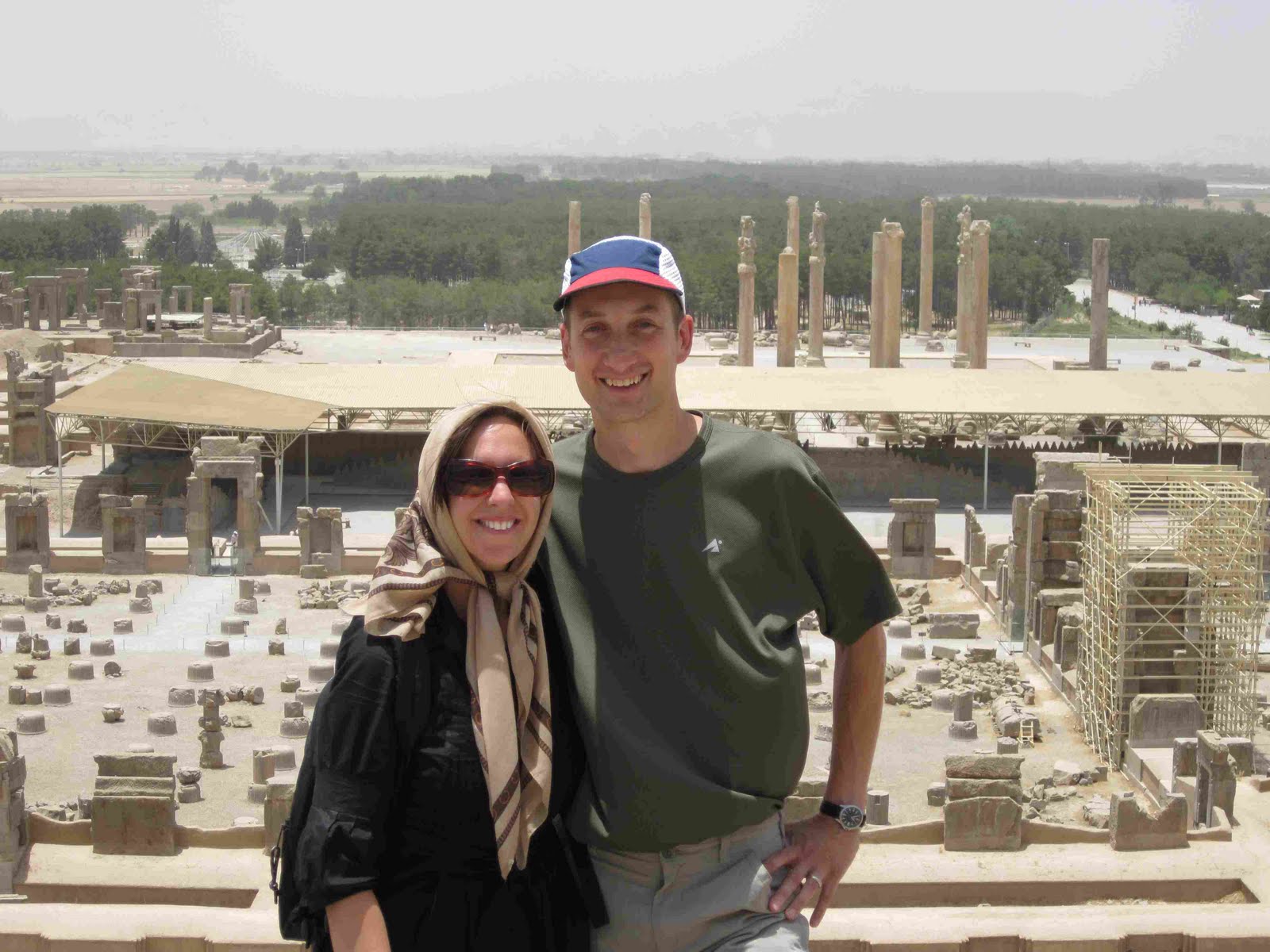
After a good night’s rest we drive back out of Shiraz to Persepolis. Persepolis came to power around 500 BC and embodies the success and power of the Achaemenid Empire, a great empire that preceded the Greek and Roman Empires. The Achaemenids ruled a vast multicultural empire. Darius tells us all about this Persian Empire, including that this was the first city where scholars have proof that people bought insurance for things.

The entrance to Persepolis gives the visitor an idea of how magnificent this ancient city must have been.


Once inside the city there are many different things to see but one of the most impressive to me was the wall of bas-reliefs showing people from 23 nations bringing gifts typical of their homelands to the Acheamenid King. Even after 2500 years the bas-reliefs are still incredibly clear and illustrative.

 
The sun is very intense but we deal with it ok and have some refreshments in a little café next to the ruins where I enjoy a blackberry juice with real blackberry bits in it. Then we visit the tomb of Artaxerxes II, one of the Acheaminid kings, which overlooks the city. From the front of the tomb you can get a feel of how extensive Persepolis is.
 

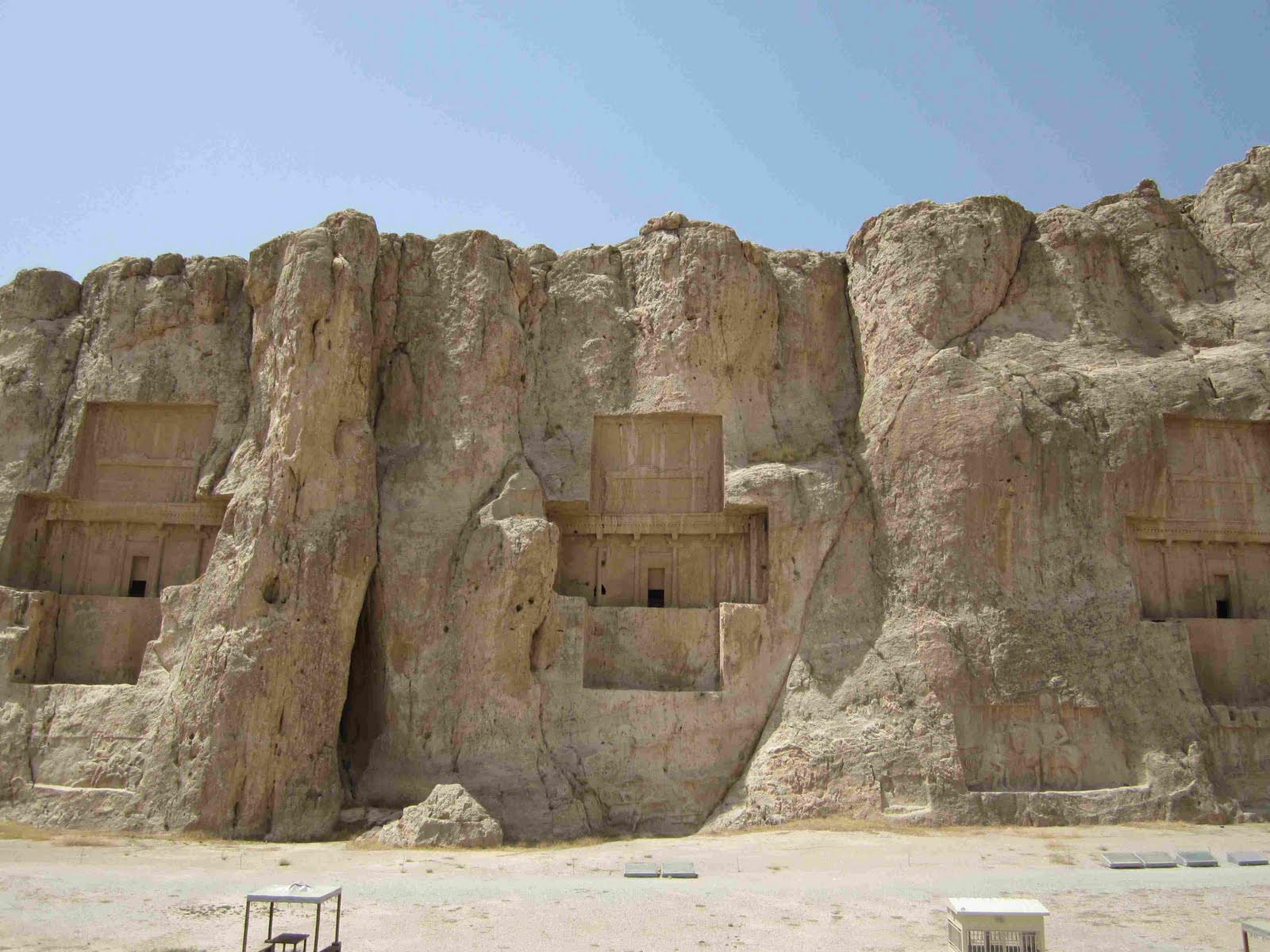
We have lunch in an outdoor restaurant a few km away with a pond and fountains, then continue to the tombs of Xerxes, Darius I, Artaxerxes I and Darius II at Naqsh-e Rostam, all of which were Acheaminid kings. These are huge tombs cut into the rock cliffs. They were completely covered in dirt that slowly blew here until they were excavated earlier in this century.


Also cut into the rock are stone reliefs depicting various military victories of the Acheaminids. Later, after Darius notices my Martian Marathon t-shirt, I learn that the Achaemenids (Persians) and Greeks fought a battle at Marathon and when the Persians lost, legend has it that a Greek soldier ran to Athens (26.2 miles) to proclaim that the battle was won, then passed out and died. These are the kings whose defeat “created” the marathon.

More detailed history for history buffs and marathon runners (mostly taken from Lonely Planet): The Greeks assisted the cities of Iona in their attempt to overthrow Persian rule. In response the Achaemenid king Darius I swore revenge on Greece. In 490 BC he sent a force to attack Greece. There was a standoff and then stalemate at Marathon. For reasons that are not completely clear the Greeks attacked and with their heavier arms defeated the Persians, who retreated to Asia. Darius began raising a huge new army but when the Egyptians (who were under Persian rule) revolted it postponed his plans. After Darius died Xerxes I restarted preparations and attacked in 480 BC. The first battle at marathon was a watershed in the Greco-Persian wars, showing that the Persians could be defeated. Historians see the Battle of Marathon as a pivotal moment in European history.

After seeing the tombs we drive back to Shiraz and visit a huge Bazaar with lots of people, tons and tons of shops packed with goods, some of which are really cool. I wish we had bazaars like this at home for Christmas shopping! We buy some rose water and Bidmeshk (Egyptian willow) extract drink. It is really yummy.

After the bazaar we walk to a restaurant that has a live four-member Iranian band (singer, violin, dulcimer, drum). The food is great (I have eggplant/yogurt dip with bread, salad, Mahi kabab, dessert of figs and sweet paste) and it is so cool hearing and seeing the band. What a great night. Darius has really organized a great day for us.

The next day, on June 23rd we visit the Sa’di shrine in Shiraz. Sa’di is one of Iran’s most beloved poets. He died in 1291 and wrote a great deal about roses and love. Then it is back on the road to drive to Yazd.

Esfahan (June 19-21)

After a long drive from Qazvin and Alamut Valley on June 19th we reach Hotel Julfa in the famous city of Esfahan. Esfahan is the second of three things that I really looked forward to seeing in Iran.

When we arrive Darius jumps out of the car to tell the hotel we are there and to ask where we should park. I’m directed to put the car on the marble floor right in front of the hotel’s main entrance, I presume for us to unload our things. But no, we are once again the honored guests and our car should stay there. Our Lonely Planet guidebook expresses it very well with “They (Iranians) are generally warm and welcoming to a degree that can be, and often is, embarrassing to Westerners.” Darius mentions to the hotel that our guide book says the rooms here are small so the hotel we gives us a gigantic room with a queen bed, 2 twin beds, a table with 4 chairs, a refrigerator, a closet and a bathroom so big that if there were more shower heads a whole swim team could shower in it at once.

The next morning we walk into the city. We walk over Si-o-she Bridge, a beautiful bridge with 33 arches, look into a madrasa (a Muslim seminary) and walk through Honar Bazaar. Then we visit Chehelsotoon Museum, which was a reception hall and pleasure pavilion built around 1647 and is completely covered in frescoes on the inside. The photo below shows the front entrance of Chehelsotoon.


Then we walk to Imam Square (Naqsh-e Johan Square), the main square of Esfahan. It is a magnificent square, sometimes described as “half of the world” because of all the majestic buildings on it: Sheik Lotfollah Mosque, Imam Mosque, Ali Qapu Palace, two bazaars and a number of shops around its perimeter. The photo below shows one corner of the square including Imam Mosque.
 

On the square we start with Ali Qapu Palace, the 16th century residence of Shah Abbas, where we meet two Iranian sisters whose father was a general for the Shah of Iran before the Islamic Revolution of 1979. The older sister was already married and stayed in Iran. The younger one fled to the United States and lives in Miami. Now the younger sister is visiting her sibling and they are touring Esfahan like we are. Darius, who supports the current system in Iran and the younger sister who thinks the current system has ruined Iran have a very lively discussion. The younger sister isn’t afraid to speak her mind and it’s really great to watch this debate. A small example is the younger sister says women are oppressed by the dress code in Iran while Darius argues that the dress code is for the benefit of women so men don’t bother them. But to this the sister counters, “well men here should learn to control themselves.” The exchange continues on a variety of topics regarding modern Iranian culture, society and politics.


We walk across the square to Sheik Lotfollah Mosque, whose entrance and prayer hall are shown in the photos below. The mosque was completed in 1619 and was used by the women of the Shah’s harem. It is written and I agree that it is arguably the most fabulous mosque in Iran. It is unusual because it has neither a minaret nor a courtyard because it was not intended for public use. The entrance is beautiful, the hallway to the prayer room is beautiful, and the inside is absolutely stunning. This mosque is one of the most beautiful buildings I have ever seen anywhere. It makes extensive use of cream colors, in addition to the signature blue and turquoise colors typical of Esfahan. The portal window inside is amazing.


After seeing Sheik Lotfollah Mosque, we have tea with Darius and the two Iranian sisters in Azadegan Teahouse (photo below). It is a really cool place that is overflowing with character. All kinds of lamps, paintings and stuff hang from the ceiling. Kirstin and I share a portion of lentil/sheep stew with bread and a type of relish. Darius enjoys a water pipe. It’s great to talk to the two Iranian women about Iran and its relationship with the US and the West.


After enjoying lunch at the teahouse we walk back to Imam Square and meander through two bazaars. This is where I notice the copper lacquerware vases, bowls, cups, etc., that Esfahan is famous for. The pieces are painted white, blue and turquoise, which makes them looks like porcelain. Then we head back to our hotel, where Kirstin rests (she hadn’t been feeling well), does some e-mail and visits an Armenian salon. Darius and I go for a walk to one of the famous bridges in Esfahan and enjoy some spaghetti ice cream (also famous here) and have a really great talk about why Iran doesn’t have better relations with so many countries. Darius’ main point is that Iran should be treated with more respect by the US and other countries. We also talk about what I do with the Fulbright Association and how important I think international exchange is. Darius says that God sees what I do and that I’m a good person. We also talk about Darius wanting to visit the US some day. I can’t tell him anything about getting a visa but I tell him about car rental, hotels, camping, things to see and how he may find things. It’s fun thinking about my impressions of Iran but in reverse. I hope he and his family can visit the US some day and it would be really cool to see him there. Back at the hotel we meet up with Kirstin and have a nice dinner in a traditional Iranian restaurant next to our hotel.


The next day we visit the (old) Jameh Mosque. It is an incredible mosque complex that has been built over such a long time that it is like a museum of Islamic architecture, starting in the 11th century and spanning 800 years. We tour the mosque and Darius explains some of the main beliefs and practices of Islam. The courtyard of the Jameh Mosque is shown below.


Then we go back to Imam Square to see the Imam Mosque. This is a huge, working mosque that our Lonely Plant guidebook calls one of the most beautiful mosques in the world. It has a very impressive entrance that is aligned with the square, then you turn a corner to the courtyard with four Iwans (like a gate or altar). Absolutely everything is covered with floral artwork (Islam forbids images of people or of things that make us think of this world). The size of this mosque and the amount of artwork in it is overwhelming. The photo below shows one part of the mosque. After visiting the mosque we do a little shopping, exchange money, check out of our hotel and make the long drive to Shiraz…


Saturday, August 7, 2010

Alamut Valley and the Castles of the Assassins (June 18)

Hiking in the Alamut Valley was one of the things that I most wanted to do in Iran. On our trip we are doing so much driving and I was really looking forward to getting away from the car and using my legs a bit. Also, since the Iranian government only approves Americans to stay in hotels in cities in Iran, this means we will be seeing mostly cultural things and being in nature for a day will be a nice change.

The Alamut Valley is in the Alborz Mountains in the north of Iran. This Alborz contain Iran’s highest peak, Mt. Damavand (5671m), and they extend right to the Caspian Sea. Aside from being very beautiful, the Alamut Valley also contains the Castles of the Assassins, a legendary group of 12th century castles that sheltered the followers of Hasan-e Sabbah, the spiritual leader of the Ismaili sect of Islam.

We start our day early for the three hour drive from our hotel in Qazvin to Garamund in the Alamut Valley. The road is a race car driver’s dream. I think the entire route doesn’t have a straight section on it. It is filled mountain hairpins, fast sweepers, steep sections up and down and a few road hazards like uneven pavement sections or potholes. There are only a few other cars on the road and there are effectively no speed limits – the police stay away from here and the road really doesn’t allow you to go much over 95 km/h anyway. And all around is incredibly beautiful scenery. But if you mis-judge a turn you are dead because there are no guardrails to protect you from going right off the edge. Driver’s skill, the car’s handling and brakes are really, really tested here but what fun this is!


At Garmarud the road becomes a 4WD track. It’s also a lot of fun to drive but a totally different experience! We climb up to 10,000 feet, mostly in first gear and in 4WD. Near Salambar Pass we park the car and start our hike past Pichebon Caravanserai (used by traders through the ages), over the pass, and down towards the Caspian Sea. There are glaciated 4000m+ peaks to our south, the earth has all kinds of interesting minerals and stones, the temperature is perfect with a few clouds, a nice breeze and dry air and we have a wonderful time. There are little yellow flowers and small pink bushes around us. We stop for a picnic lunch, then return to the car for the drive back. Today is the first day that the flu I got in Turkey is completely gone. I think I needed the fresh air and to get my blood flowing again.


We return to Garmarud at the bottom of the 4WD track, drive into a different valley to see Alamut Castle, which is a ruin on top of a peak (I can see how this place was impenetrable), then drive the race car driver’s road back to Qazvin. Now there are more cars but everyone is flying. People here really know how to drive! I have no idea how they can get these little old cars with no power up these roads as fast as they do. People are picnicking by the road, playing music, and enjoying the wonderful weather and scenery. One woman is sitting in the rear side window of a car as the car flies up and down the mountain roads. Darius plays us some of his favorite tunes on his phone. Everyone is enjoying life.

When we arrive back in Qazvin I’m exhausted but Darius who never runs out of energy (we nickname him Energizer Bunny) talks us into going out to a tea house. The place he takes us to is so cool! High ceiling, carpets all over, cool decorations. We sit Indian style on one of the platforms with pillows behind us and order some chicken kebab and tea. At 10:00 the place starts to really fill up. Iranians know how to have a good time.


I’m so happy that we could hike the Alamut Valley. We are truly blessed to be able to experience all this and to have Darius as our guide.

Friday, August 6, 2010

First Days in Iran (June 15-17)

First Day in Iran

On June 15th we entered Iran and what a day it was! We experienced more and had more adventure and stress thrown at us than during any day of our trip until this point, even after driving through 9 countries in the past 41 days. Today was a really, really challenging day that took all the strength I had.

The day started very early at a campground in Dogubayazit, Turkey, where the night before we ate dinner amongst roaming farm animals, went to sleep in the middle of a concert, and woke up at 4:30 a.m. to a flock of very loud crows. Our day continued at the Turkey-Iran border with all the Boris and Muscle Man Carnet de Passage commotion (see last blog entry). And then we had an 8 ½ hour drive through Iran, mind you the first time I’ve driven here! Iran is certainly one of the more difficult places in the world to drive until you learn their system of how things work. It’s much like learning a foreign language – easy and makes some sense once you know it but you’re totally lost in the beginning.

Our itinerary had us driving 580 km to Takab today but since IranianVisa, our visa and guide agency, put our guide on a late train to the border without telling us or adjusting our itinerary, our 3:30 p.m. start from the border would make reaching Takab impossible. It took us the next 8 ½ hours to go 300 km to Orumiyeh, when our first day would finally end at midnight. The road surface is pretty good for the most part but the roads are small and winding so progress is slow. The scenery is beautiful though – dry, mountainous terrain, small villages, no trees. Here some sheep are being led across the road.


Car in the gutter

I had read that in Iran many street gutters are on (not below) the surface and one must be careful not to accidentally drive into one when parking or entering/exiting a driveway. The gutters are concrete gullies about 18” deep, 18” wide at the top and slightly narrower at the bottom. As you can imagine, it would be very bad if one or more wheels were to fall into such a gutter.


What I didn’t expect is that when these gutters cross the road sometimes not the entire length of the gutter is covered with a grate. So I’m driving through a village with two lanes on our side of the road and a car behind me obviously wants to go faster than me so I move over to the right lane. Just then one of these gutters crosses the road and I don’t see (until the last instant) that the grate covering the gutter doesn’t extend to the right lane. I can’t swerve back because the car is passing me so I hit the brakes to try to stop or at least slow the car down before this 18” trench. Thankfully the pavement here was good and I am nearly able stop the car, but the front right tire drops in. Thank goodness we have big tires and our 4Runner has lots of ground clearance so the body of the car remains just over the edge of the gutter by a fraction of an inch. In 4WD I’m able to back out and breathe a sigh of relief. I tell myself that I can’t let something like this happen again – this could have been really bad!

Armenian Church

Along the way we stop at Qareh Kalisa (Church of St. Thaddaeus) near Maku. It is an Armenian church that many ethnic Armenian pilgrims from Iran and Armenia visit every year. It is also Iran’s best maintained medieval church. It’s great to see it; I’ve never seen a church in this style before.


Speed Limits in Iran

As we drive further I learn about speed limits in Iran. As in much of the world (unlike in the US), speed limits are normally not posted – you just have to know when which limit applies. The default limits in Iran are 60 km/h in a city or village, 95/85 out of the city during day/night, 110 km/h on 3-lane roads and 120 km/h on expressways. These are the limits unless another speed is posted.

Just when I think I have it I get pulled over for speeding. I was passing a truck in a 95 zone. To get around the truck safely before the next corner I accelerate to 110 as I pass it and this is when I was caught. Darius our guide thankfully jumps out of the car and talks to the cop and gets me off. Thank you Darius!

So why am I one of the slowest cars on the road and I get pulled over for speeding? What’s the scoop, Darius? He explains that in cities the limit is 60 and often posted at 40, but you should generally go 70. The lower limits are not enforced and are only warnings to take care. It is fine to pass slower cars and trucks on 2-lane roads, even in the middle of a city or village, but the 95 limit out of the city is a hard limit. Don’t exceed 95 even while passing. See, easy, once you know.

Dinner on the Street

At about 8 p.m. we stop in one of the towns along the way for a quick dinner. We buy some barberie bread (translated, barbarian bread) and non-alcoholic fruit beer. The bread is fresh (it came out of the oven just a couple of minutes ago) and the beer is really, really tasty. Normally I don’t like non-alcoholic beer but this is excellent. It tastes like wheat beer with a bit of fruit syrup. There are all sorts of flavors to choose from. The bread is incredibly cheap, something like $0.10 per loaf. In a typical gesture of Iranian hospitality, the shop owner we buy the beer from brings stools out for us to sit on, even giving us his own stool. Below you can see our dinner in front of the shop.


After dinner it is dark and my neck hurts from our border experience, from driving so much and the remnants of the flu I had in Turkey. Kirstin doesn’t want to drive so I take 2 Advil and get back behind the wheel. Darius kindly offers to drive but he isn’t insured under our insurance policy so I’m stuck and bear down to the task at hand. We have a long way to go.

I drive through my first city in Iran in the dark with people, cars and motorcycles everywhere. Darius begins to explain in great detail about accidents in Iran. For damage to cars the police decide who is at fault and they must pay. If you injure a pedestrian, motorcycle or moped the car driver is always guilty. If case of a death the driver must pay “blood money”. For a man with a family blood money is about $80,000, for others it is about $40,000. The driver must pay unless the family refuses because they don’t need the money or say that no money can replace the lost person. I try to drive really carefully. It is crazy driving through cities at night. I can’t explain what it is like but for a Westerner it is nerve racking scary!

At about midnight we get to our simple but clean hotel in Orumiyeh. What a day! We survived the border and out first day in Iran. Sleep!

World View of a Patriotic Iranian Veteran

On June 16th we drive from Orumiyek to Takab. On the way Darius tells us about the First Gulf War (known as the Iran-Iraq War in the US), Iranian history and Iran’s often strained relationships with other countries, from his perspective. He is a veteran of the First Gulf War and is proud of his country, Persian history, and is generally supportive Iran’s current government. I don’t agree with everything he says but it is great to hear his perspective. He is a good, honest, trustworthy, caring person and a patriotic Iranian. I find what he says very interesting and try to put my head around what he says.

I have been trying to reconcile how it is possible that Iran is filled with so many wonderful people while Iran has such a poor reputation in the world because of the actions of its government and Darius’ explanations help me with this.

Why Does Everyone Blink their Headlights at Us?

Today we figure out why everyone keeps blinking their lights at us. Every day dozens, perhaps even a hundred people flash their lights at us or signal with their hands out of the window that our lights are one. Even pedestrians tell us through the window. They are concerned that our lights are on. Our car has “day running lights”, which means the headlights are always on, on a slightly dimmer brightness than when you turn your lights on. This is intended to be a safety feature and is even required by law in many countries.

But the majority of Iranians feel we are wasting our lights or energy. It’s really funny how different things bother different people. Darius doesn’t wear a seatbelt, motorcycles, mopeds and bikes don’t use helmets, roundabouts have no right of way, and neither do intersections! Cars and trucks don’t use lights at dusk, some not even at night. Some people use them but turn them off when you come near. Almost nobody uses blinkers. But everyone is concerned that my lights are on! Everyone has their pet peeve and for Iranians it is having your lights on during the day.

Takht-e Soleyman

At about 4:45 we get to Takht-e Soleyman. It’s an old castle and holy place for Zoroastrians. Zoroastrianism is the first monotheistic religion. They are dualists – the world is a struggle between good and bad. They believed there are 4 elements that should be revered: earth, air, water, fire. At Takht-e Soleyman there is a deep well that makes a really cool crater lake, a natural gas vent that can sustain a flame, and lots of earth and air.


Then we visit Zendan-e Soleiman, a 97m conical peak with a dizzying void in the middle, very close to Takht-e Soleyman. Zendan-e Soleiman means Solomon’s prison. We hike to the rim and peer inside. Wow! On the way down we are invited to tea by the Kurdish caretaker. He has picked some herbal flowers and makes tea with it. He is an adorable, handsome Kurd with smooth, dark, healthy skin and blue eyes. He lives in a village about 5 km away that he walks from and to each day. He is really kind. He lived in Tehran for a year but decided to come back to his village.


After visiting Zendan-e Soleiman and having tea we head for our hotel in Takab. We check in about 10 p.m., park in the underground garage (super tight and steep drive – I need 4WD to get out of the cement drive the next day), have some soup, salad and yogurt for dinner.

Oljeitu Mausoleum in Soltanieh

On June 17th we are on the road at 7:20 a.m., then stop later in the morning to eat the take-away breakfast our hotel prepared for us the night before. The first half of today’s 400 km drive is on a beautiful winding road through the mountains and the last half is on a good expressway where we can go 120 km/h. During the day we stop in Soltanieh to see the Oljeitu Mausoleum, the world’s tallest brick dome. The dome is a beautiful blue dome on a tan structure that used to have blue tile on the outside and still has lots of decorations on the inside. The Mausoleum’s sponsor was Mongol Sultan Oljeitu Khodabandeh, who changed religions several times. While he was a Shiite he and his favorite concubine wanted to move the remains of Iman Ali from Najaf (in present day Iraq) to here to make it the 2nd holiest Shiite site (after Mecca). Khodabandeh didn’t succeed and was eventually buried here himself. This is our wonderful guide Darius, standing in from of the mausoleum.


Stani and Darius find a way to get around our Tour Agency

At this point Darius is able to reach IranianVisa (our tour agency) on his cell phone and is informed that since we are behind schedule (because they didn’t get Darius on a train to the border on time) and they can’t change our reservations in Esfahan (I think they would have to pay something to change the reservation), they have cut our hiking trip in the Alamut Valley. I’m pretty upset by this because this hike is one of the few things that I really wanted to do in Iran and since January I’ve been telling IranianVisa that I really want to spend 2-3 days here. After all the driving we have been doing I want to use my legs again. When I call IranianVisa they conveniently won’t pick up the phone and then won’t return my messages.

But Darius and I find a way around these bozos. We agree that I’ll pay the hotel we are staying at in Qazvin for an extra night out of pocket and we simply won’t show up at our next hotel (which I paid IranianVisa for). This will give us a full day to hike the Alamut Valley and see the Castles of the Assassins. Then we’ll drive all the way to Esfahan the next day. Darius will cover for us with the police if there are any questions about why we aren’t saying where IranianVisa has us staying. As Americans we need to stick to our pre-approved itinerary and I’m told the police check on this. But in reality we are more closely sticking to your original government-approved itinerary, just not the latest modification from IranianVisa. Thank you Darius! We are going to hike in the beautiful Alamut Valley! I can get back to enjoying our trip.

Shopping for a headscarf, a Manateau, Bread and more Hospitality

After seeing Oljeitu Mausoleum in Soltanieh and fixing our itinerary we drive to Qazvin and check into our hotel there. We visit a camping store and buy a map of Alamut Valley. Darius would like to smoke a water pipe and we are happy to explore the city on our own a bit so we split up for a few hours. In a candy store Kirstin gets an ice cream and I get an Iranian sweet. The store owner asks where we are from and when we tell him United States he exclaims “America!” and then greets us warmly and gives us a special discount for being Americans.

Kirstin needs a proper headscarf and manateau in Iran (she has improvised until now) so we find some clothing stores and go shopping. The store owners don’t speak English and we don’t speak Farsi so it’s an interesting experience. Image buying a type of clothing you’ve never worn before and you can’t speak to the sales people. But the sales people are very nice, in one of the shops the owner finds another shop owner that speaks some English, and some of the other women customers are also very helpful. In the end Kirstin is able to find a nice headscarf and manateau.

Many people might not know what a manateau is. It’s sort of shirt or blouse that is long enough to cover the behind of the wearer. Contrary to what you may think, it can actually be quite stylish. The clothes that women wear in public in Iran basically falls into one of two categories. The more conservative outfit is a chador, which translated literally means “tent”. It is a black sheet that is worn over the head and body. Under this the woman wears pants and a blouse. It covers everything except the feet and face. Wearing a chador is considered form of modesty by many women, while others, including many westerners see it as oppressive. The other type of outfit is a headscarf and manateau, which as I said, can be very stylish. To me, women wearing manateaus in the cities look as stylish as women’s fashion in Europe. Below are photos of a woman wearing a chador and Kirstin wearing a headscarf and manateau.


Now that Kirstin has something to wear we go looking for food. We find some groceries but our best find is Sangiak bread, which is traditionally baked on a bed of stones. In our bread shop there is a large oven, similar to a pizza oven with a large rotating plate (~2.5m) with dimples on it. The woman next to me helps us figure things out. You wait in line, tell them how many breads you want (they cost $0.30 each for a thick 3’ by 1’ piece), you wait for it to cool, then put it in a bag or walk off with it. Back at our hotel we make a stop in the hotel parking garage. The parking attendant speaks no English but clenches his hands together and says America-Iran, meaning we are friends. Even the parking guy is so kind and welcoming to us. What would the average person on the street in the US say about Iranians? The hospitality here is incredible. More than in any other country I’ve visited, Iranians separate how they feel about the actions of foreign governments with citizens of that country.